There are a couple of topics I’m considering for my research paper for my Library 2.0 class.
heart & trust
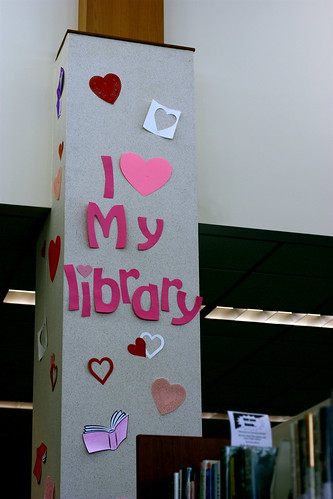 The first is what intrigued me during our first weekend in class; the importance of positive human interaction in libraries.
How can we encourage kindness and trust through library 2.0 technologies?
How can social networking be the vehicle for creating closeness and connecting library users with each other and the library staff?
How can an online community for library users create excitement and passion for services, programs, library materials and the library itself?
This topic would also lead to an analysis of how libraries can create a positive presence on the web; and how the physical and virtual spaces can remain consistent and interconnected, one being the extension of the other.
I’m thinking this would be more of a list of best practices that libraries can use to evolve their online presence and start utilizing library 2.0 technologies with their users in mind.
decisions & change
The second idea that I’m considering was inspired by my recent readings of Malcolm Gladwell’s Blink and The Tipping Point (two great reads, by the way).
 There are a lot of ideas in the two books, but what I found particularly interesting, and what I think would be extremely useful to libraries, is understanding the process of finding out what people really want before deciding on making a change (Blink) and then how to make that change really happen (The Tipping Point).
In reading Blink I learned that in order to find out what people really want, asking them is not the way to go because usually people don’t know what they want. This seems counterintuitive at first, but the truth is that people are not always good at explaining what they want, and more often than not, they really, truly don’t know what they want. This is why it’s so difficult for libraries to find out what technologies or services their patrons would like see implemented; asking them simply doesn’t work.
The second part of this is change; in The Tipping Point, Gladwell shows why some ideas take off and become popular and others don’t. There are some really important and practical lessons that libraries can learn on how ideas spread. So that once you find out what your users really want you’re able to implement that change in the right way and ensure its success.
So the questions I would be dealing with are:
- how can libraries identify which library 2.0 technologies should be implemented, or simply what’s the best way to find out what patrons really want
- how can library 2.0 technologies be implemented with success; how will patrons find out about them and learn how to use them

I guess writing this out really helped me decide which topic I should go with; I could go on and on about each, but at the moment I’m leaning towards my second choice 🙂
2 responses to “Exploring heart, trust, decision making and change in libraries”
Your two questions for the second choice are perfect – and exactly where we should be going with these discussions. I think the heart is in that choice too!
[…] Exploring heart, trust, decision making and change […]